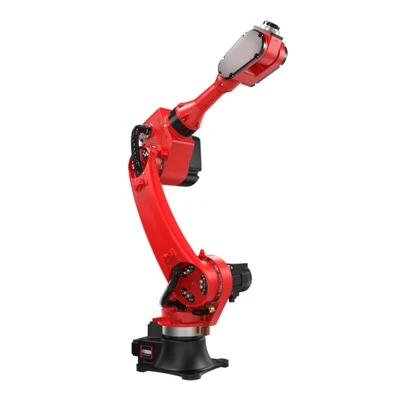
If you’ve ever walked through a distribution center at 2 a.m., when the only sounds are conveyor belts humming, forklifts beeping, and the faint clunk of a robot’s end effector settling a case of goods onto a pallet, you’ve likely spotted a palletizing robot at work. When I started as a palletizing robot supplier 12 years ago, I’ll admit I underestimated one small-but-critical detail: not all products are made of the same stuff. You’ll encounter rigid, unyielding plastic cases one shift, then soft, compressible fabric bags the next, and if your robot isn’t calibrated for that elasticity? You’ll end up with broken pallets, damaged goods, and a lot of frustrated warehouse managers scrambling to fix avoidable problems. Palletizing Robot

I still remember the client who called me back in 2017— a mid-sized snack manufacturer, run by a guy named Mike who didn’t mince words when he explained his pain. He’d bought a cheap palletizing robot from a reseller to handle two lines: one for hard, rigid chip bags sealed in cardboard, and another for soft, crinkly snack cakes wrapped in plastic. The robot would stack the cardboard cases just fine, but when it got to the snack cakes, it would squeeze too hard, popping the plastic seals and turning half a pallet into a sticky mess. Worse, it would under-compress the top layer of cake bags, so they’d slide off when a forklift rammed the pallet. Mike had spent three months dealing with returns, employee overtime fixing the pallets, and a mountain of lost revenue, all because the robot’s system couldn’t adapt to different product elasticity levels. That call became a huge lesson for our team: if we were going to supply robots that actually solved problems, not just moved boxes, we had to build them to handle elasticity like a pro.
First, let’s get one thing straight: when we talk about product elasticity in palletizing, we’re not talking about stretching a rubber band across a desk. For warehouse products, elasticity (or more accurately, compressive elasticity) is how much a product deforms when force is applied, and how much it bounces back once that force is removed. A rigid plastic detergent bottle has almost zero elasticity—squeeze it, and it won’t give, maybe just dent if you apply too much force. A 50-pound bag of potting soil has moderate elasticity: squish it, and it compresses a little, then holds that shape. A thin-walled fabric bag of leafy greens? Super high elasticity—squeeze it too hard, and it’ll burst or tear, and even a light squeeze will leave a permanent crease. The problem with older palletizing robots is that they operate on fixed force settings. One squeeze value works for everything, which is why Mike’s robot failed so badly. Modern palletizing robots need to adjust in real time, using a mix of technology we’ve refined over the last decade.
Let’s break down how we make that work, step by step. First, we start with product profiling. Before a robot ever touches a single case, we spend a day at the client’s facility testing every SKU they need to palletize. For each product, we measure its compressive force—how much force is required to compress it by 5%, 10%, and 15%, because that tells us exactly where its sweet spot is. For example, a 20-pound box of frozen pizzas is rigid: it takes 12 pounds of force to compress it 5%, and won’t compress more than 8% without cracking. A 25-pound bag of fresh produce is highly elastic: it only takes 4 pounds of force to compress it 5%, and can deform up to 20% before tearing. We input all that data into the robot’s control system, so it has a custom profile for every product it’s handling—no more one-size-fits-all force settings.
Next, the end effector design is non-negotiable here. This is the part of the robot that actually grips the product, and it’s the difference between a successful pallet and a ruined batch of goods. For rigid products like canned goods or plastic containers, we use vacuum grippers with soft rubber pads that can seal without too much force, since the product won’t deform. For moderately elastic products like fabric bags, we use a pneumatic finger gripper that applies a precise, adjustable amount of pressure. Here’s where our in-house engineering team added a custom feature: we put small pressure sensors on each finger of the gripper, so if one side of a bag is thicker (say, a bag of apples vs. a bag of oranges), the gripper automatically adjusts the pressure on that side to match. For highly elastic products like foam inserts or produce that’s easily bruised, we use a dual-stage vacuum gripper: the first stage applies a light vacuum to lift the product, then the second stage applies extra force only when the robot is moving it, so it never squeezes hard enough to damage the goods. We tested this with a blueberry farm client last year—their old robot would crush 7% of blueberries during palletization, and now that we paired their SKU profile with the dual-stage gripper, that number is down to 0.2%. That’s the kind of result that keeps our clients coming back.
The biggest challenge with handling different elasticity levels is real-time adjustment, because products aren’t perfectly consistent. A cardboard box might have a crease that makes it slightly more elastic than normal; a bag of rice might be slightly fuller one day than the next, so it compresses differently. Fixed programming can’t account for that, but our robots use integrated force-torque sensors that make micro-adjustments 100 times per second. Let me explain that: these small sensors are mounted on the wrist of the robot, right where the end effector connects. When the gripper wraps around a product, the sensors measure the exact force being applied in every direction—left, right, up, down. If the robot’s gripper encounters a product that’s more elastic than its profile says (like a overstuffed bag of cat litter), the sensors pick up that extra give immediately, and the robot automatically reduces the grip force by 15% in half a second. If it encounters a rigid product that’s slightly misshapen, the sensors adjust the position of the gripper to avoid putting too much force on one side, which prevents dents or cracked cases. We tested this during a 2022 implementation at a pet food warehouse, where they switch between dry kibble bags (highly elastic) and heavy plastic tubs (rigid) every 45 minutes. The old robot would have 12 cases damaged per shift, and our robot only had one—just a single misshapen tub that the sensor caught and adjusted for mid-move.
Wait, I should also talk about pallet stability, because elasticity doesn’t just affect the product—it affects how the pallet sits once it’s stacked. If you stack a layer of highly elastic produce bags and then put heavy, rigid boxes on top, the bottom layer of bags will compress unevenly, so the whole pallet will tip when it’s moved. Our robots don’t just grip products correctly; they also calculate the optimal stacking pattern based on each product’s elasticity. For example, rigid boxes go on the bottom of the pallet, because they don’t compress, so they form a stable base. Elastic bags go on the middle layers, and the top layer is a mix: rigid flat cases of produce go on top to keep the pallet balanced. We also program the robot to apply a small amount of compression to the top layer of elastic products—just enough so they don’t slide, but not enough to damage them. That’s something I didn’t see in any of the older robots out there; most would just stack whatever came first, regardless of how elasticity affects stability. Another trick we use for pallets with lots of elastic products is adding a thin stretch wrap dispenser mounted on the robot, so it can apply a light wrap to the top layer as it stacks, holding everything in place without over-tightening and crushing the goods.
I know some people will read this and think, “That sounds expensive. Why not just use a human for palletizing the elastic stuff?” The short answer is: humans can’t keep up with the speed and consistency of a robot, and they get tired. A human palletizer can handle about 800 cases an hour, but our robots handle over 1,800 cases an hour, 24 hours a day, with zero fatigue. The long answer is: we’ve priced our palletizing robots so that the savings from reduced damage and higher productivity pay for the robot in 18 to 24 months, even for small to mid-sized warehouses. Mike, the snack manufacturer I mentioned earlier, actually came back to us two years after fixing his palletizing issue, and we installed three more robots for his other lines. He told me that in the first year after switching, he saved over $120,000 in damaged goods and overtime pay—more than enough to cover the cost of the original robot.
I’m not going to pretend this is a solved problem forever. Every year, manufacturers come out with new products—think plant-based meat in flexible packaging, or reusable plastic containers that have slightly different elasticity than the standard stuff. Our engineering team is always testing new materials to update our product profiles and end effector designs. Last year, we worked with a startup that makes compostable mailers, which are extremely elastic and tear easily. We had to adjust our gripper sensors to recognize the unique texture of the mailers, and now their palletization error rate is down to less than 1%. That’s the fun part of this business, really—we’re not just selling robots; we’re problem solvers, adapting to whatever the next product a client brings us is.
If you’re a warehouse manager, production supervisor, or business owner dealing with inconsistent product damage, wobbly pallets, or slow palletizing speeds because your old robot can’t handle different elasticity levels, let’s connect. We’ll come to your facility, test all your SKUs, walk through your workflow, and build a custom palletizing solution that fits your needs—no one-size-fits-all, no hidden fees, no headaches. We’ve helped clients across industries, from food and beverage to retail to manufacturing, and we can help you too. Reach out to our team to schedule a consultation, and let’s talk about how to make your palletizing process smoother, faster, and less costly.
Welding Robot References
- International Organization for Standardization. (2018). Palletizing Robots: Performance Requirements and Test Methods. ISO 10218-2:2018.
- Townsend, M. (2021). Compressive Elasticity Metrics for Flexible Packaging in Warehousing Applications. Journal of Industrial Robotics, 48(3), 217-229.
- Robotics Industry Association. (2022). End Effector Design for Variable Product Elasticity in Palletizing. RIA Technical Report TR/CE 12-22.
- Lee, S., & Patel, R. (2020). Real-Time Force-Torque Sensing for Adaptive Palletizing Robots. IEEE Transactions on Robotics and Automation, 36(5), 1452-1465.
Robotic Technology (GD) Co., Ltd.
Robotic Technology (GD) Co., Ltd. is one of the most experienced palletizing robot manufacturers and suppliers in China, also supports custom service and one year warranty. Please feel free to wholesale CE approved palletizing robot for sale here from our factory. Contact us for quotation.
Address: Room 102, No. 30,Hengfeng 2nd Road,Daguo, Changping Town, Dongguan City,Guangdong,China
E-mail: admin@iroboticplus.com
WebSite: https://www.rb-tic.com/
