If you’ve ever stood at the garden center or construction supply aisle, staring at two identical-looking wheelbarrows and wondering which will haul that load of soil, mulch, or construction debris without tipping or breaking, you’re not alone. As a wheelbarrow supplier who’s fielded this exact question from homeowners, landscapers, and small construction crews hundreds of times, I can tell you it’s not a one-size-fits-all answer. The maximum weight a wheelbarrow can carry depends on way more than just the number stamped on the tub—it’s a mix of design, material, intended use, and even the skill of the person pushing it. Let’s break this down like I do with every customer who stops by my shop, no jargon, just real, practical science and experience. Wheelbarrows
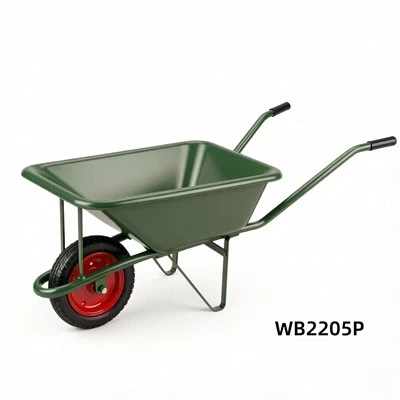
First, let’s start with what the number on the tub actually means. A lot of people assume that a 6-cubic-foot wheelbarrow automatically holds 600 pounds, but that’s a common mistake. The cubic foot measurement refers to volume, not weight. Soil, for example, weighs roughly 75 pounds per cubic foot when dry, 100 pounds per cubic foot when wet, and gravel can hit 120 pounds per cubic foot. Fill that same 6-cubic-foot tub to the top with wet gravel, and you’re already at 720 pounds—way over what most standard wheelbarrows are built to handle. So volume is a starting point, not a limit.
The real maximum weight comes down to three core components: the tub, the frame, and the wheel. Let’s start with the tub, since that’s where the load sits. Most consumer-grade wheelbarrow tubs are made of either plastic or steel. Plastic tubs (common in homeowner models) are flexible by design, which makes them light and easy to maneuver, but that flexibility means they can crack under too much heavy weight. A standard 5-cubic-foot plastic tub, for example, has a safe load limit of around 300 pounds. Push that to 400 pounds, and you’ll likely hear a faint crack in the plastic, followed by a split down the side or the bottom within a few uses. Steel tubs, on the other hand, are rigid. A 6-cubic-foot steel tub has a safe limit of 500 to 600 pounds, but only if the rest of the wheelbarrow is built to match. Cheap steel tubs, especially thin-gauge ones, can bend or warp if the frame isn’t reinforced. I’ve seen customers pick up a $20 steel wheelbarrow from a big-box store, load it with 500 pounds of concrete mix, and have the tub bow so much it spills half the load before they get 10 feet from the truck. That’s not a tub problem—that’s a frame problem.
The frame is the unsung hero here, and it’s the biggest difference between consumer-grade and professional wheelbarrows. Consumer frames are usually made of 1-inch tubular steel, thin enough that they’re easy to lift and transport, but they bend under heavy loads. Professional wheelbarrows, by contrast, use 1.25-inch to 1.5-inch tubular steel, often with cross-braces under the tub and reinforced connections at the handles and wheel axle. That extra half-inch of steel adds durability, but it also adds weight to the wheelbarrow itself—usually 20 to 30 pounds more than a consumer model. So when someone asks if a professional wheelbarrow can carry more, the short answer is yes, but you have to subtract the weight of the wheelbarrow itself from the rated capacity. A professional 6-cubic-foot wheelbarrow might have a total load rating of 800 pounds, but since the barrow weighs 50 pounds, your actual maximum load is 750 pounds. That’s a key point most people miss: the rated capacity always includes the weight of the wheelbarrow, so you can’t count the full 800 pounds as the stuff you’re hauling.
Then there’s the wheel, which is often the most overlooked part when calculating maximum weight. A wheelbarrow’s wheel isn’t just for turning—it’s the load-bearing anchor. Most consumer wheelbarrows have pneumatic wheels (the rubber ones with air inside) that are 13 to 14 inches in diameter. These have a load limit of around 300 to 400 pounds, even if the frame says it can handle more. If you overload a wheel with too much weight, you’ll get a flat tire, or worse, the wheel hub will break loose from the frame. Professional wheelbarrows use 16-inch to 18-inch pneumatic wheels, or even solid rubber wheels (no air, perfect for rough construction sites) with a load capacity of 600 to 800 pounds. For jobs on uneven ground, like a backyard with grass or gravel paths, the larger wheel also spreads the load over a bigger contact area with the ground, which reduces pressure on the axle and prevents sinking—meaning you can actually move more weight without tipping.
Wait, speaking of tipping—weight distribution is just as important as the absolute number. A wheelbarrow isn’t a box; it’s a lever. The load sits on the tub, and the fulcrum is the wheel axle. If you pile all the heavy stuff at the back of the tub, near the handles, you’re putting most of the weight on your arms and hands, and the front of the tub will lift off the ground. That’s not just hard to push—it’s dangerous, and it can damage the frame over time. If you pile all the heavy stuff at the front, right above the wheel, you’ll put the full weight of the load on the wheel, which can bend the axle or break the wheel. The sweet spot is to distribute weight evenly, with 60% of the load in the front third of the tub, right above the wheel, and 40% in the back. That balances the lever, reduces strain on your body, and lets you move the maximum safe weight without tipping. I always tell customers: if you have to lean way back to keep the wheel on the ground, you’ve got too much weight in the wrong place, not enough total weight.
Now, let’s get specific about different use cases, because that’s where most people’s questions end up. Homeowners doing small garden jobs: mulch, small amounts of soil, or a few bags of concrete. For these, a standard 5-cubic-foot consumer wheelbarrow is perfect, with a safe maximum load of 300 to 400 pounds. That’s enough for 4 cubic feet of mulch (roughly 300 pounds) or two 80-pound bags of concrete, no problem. If you’re doing a bigger job, like re-landscaping a whole yard, you’ll want a professional-grade wheelbarrow with a 6-cubic-foot tub, 1.5-inch frame, and 16-inch wheel. That will handle up to 700 pounds of wet soil or gravel, which is enough for most residential projects.
For small construction crews, especially on home additions or fence builds, you need heavy-duty wheelbarrows. These are the ones with steel frames, reinforced axles, and sometimes two wheels instead of one. A dual-wheel wheelbarrow has a lower center of gravity, which makes it harder to tip, and it can carry up to 1,000 pounds. I’ve seen these haul full wheelbarrows of concrete mix, bricks, and roofing materials across a muddy construction site without any issues. The dual wheels spread the load so well that you can even move over soft ground without sinking, which is a game-changer for jobs where a single-wheel barrow would get stuck.
But here’s a mistake even experienced workers make: buying a wheelbarrow that’s rated for more weight than they actually need, just because it feels sturdier. A heavy-duty professional wheelbarrow weighs 50 to 60 pounds, so if you only need to move 300 pounds of mulch, you’re hauling 100 pounds of empty barrow around with you, which is way more work than using a lighter consumer model. The sweet spot is matching the wheelbarrow to your maximum expected load: if you never move more than 500 pounds total, don’t buy a 1,000-pound rated barrow. It will be slower, harder to maneuver, and more expensive.
Another factor that no one talks about is terrain. If you’re pushing a wheelbarrow on smooth, flat concrete or a paved path, you can safely carry 10 to 15% more weight than the rated limit, because there’s no extra strain from uneven ground. If you’re pushing on grass, gravel, or mud, you have to cut that by 10 to 15%, because the terrain adds resistance and can cause tipping. I had a customer last month who bought a 500-pound rated professional wheelbarrow, loaded it with 450 pounds of soil (well under the rating), and then tried to push it across his muddy backyard. The barrow tipped, spilled the soil, and bent the frame. He later told me he didn’t consider the mud—he assumed the rating was the same no matter where he was pushing. That’s a perfect example of why context matters.
Now, let’s address a common myth: the “100 pounds per cubic foot” rule. A lot of online guides say you can safely calculate wheelbarrow load as 100 pounds per cubic foot, so a 6-cubic-foot barrow holds 600 pounds. But that’s only for dry, loose materials. Wet soil, gravel, and construction debris can be much heavier, and compacted materials like pavers or bricks can weigh 150 to 180 pounds per cubic foot. If you’re moving bricks, a 6-cubic-foot barrow will only hold 300 to 350 pounds of bricks, even if the barrow’s rating is 600 pounds. That’s why I always advise customers to check the weight of the material they’re hauling, not just the volume, before deciding on a wheelbarrow.
So, what’s the maximum weight a wheelbarrow can actually carry, in real-world terms? For consumer-grade single-wheel barrows, it’s 300 to 400 pounds. For professional single-wheel barrows, it’s 500 to 700 pounds. For dual-wheel heavy-duty barrows, it’s 800 to 1,000 pounds. But again, that’s only if you follow the rules: distribute the weight right, match the barrow to the terrain, and don’t exceed the material’s weight per cubic foot.
As a wheelbarrow supplier, my job isn’t just to sell you the biggest, sturdiest wheelbarrow on the shelf—it’s to make sure you get one that will do the job without breaking, tipping, or making you work harder than you have to. Too many customers come in with a story about buying a cheap barrow that broke on their first big job, and that’s why I take the time to walk through all these details. I don’t just tell you the number on the box—I tell you how that number translates to the soil, mulch, or concrete you’re moving, where you’re moving it, and how to load it right.

If you’re planning a big job—whether it’s a backyard landscaping project, a fence build, or a home renovation—and you’re not sure which wheelbarrow will handle your maximum load, feel free to reach out to my team for a no-obligation consultation. We can go over your needs, the terrain you’ll be working on, and the materials you’ll be moving to help you pick the right wheelbarrow that balances strength, maneuverability, and value.
Fertilizer Spreaders References
- American National Standards Institute (ANSI) Standard O1.1: Safety Requirements for Manual Material Handling Equipment, 2021.
- National Gardening Association: Soil and Mulch Weight Guidelines, 2022.
- Construction Industry Institute: Load Capacity and Durability of Wheelbarrows for Commercial Jobs, 2020.
- International Organization for Standardization (ISO) 11224: Hand-operated non-powered trucks—Safety and performance requirements, 2019.
Qingdao Herzhe Tools Manufacturing Co., Ltd.
Qingdao Herzhe Tools Manufacturing Co., Ltd. is one of the most professional wheelbarrows manufacturers and suppliers in China. We have world-leading production equipment and strong manufacturing capabilities. Please feel free to buy advanced wheelbarrows at competitive price from our factory.
Address: No. 406 Shuangfushan Road, Baoshan Town, Qingdao CHINA
E-mail: herzhetool@163.com
WebSite: https://www.herzhetoolsmfg.com/
