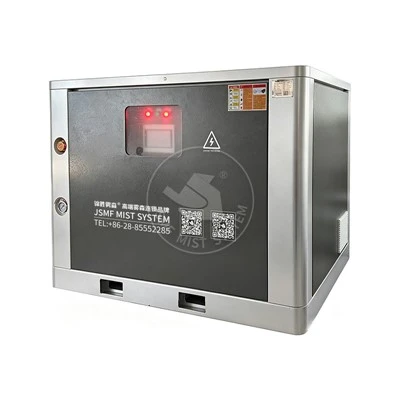
Mist generators have become increasingly popular in various industries, including agriculture, horticulture, industrial cooling, and even in some specialty residential applications. As a supplier of high – quality mist generators, I often get asked about the mist dispersion range of these devices. Understanding this aspect is crucial for customers to make informed decisions about which mist generator is most suitable for their needs. Mist Generator
Factors Affecting Mist Dispersion Range
The mist dispersion range of a mist generator is not a fixed value; rather, it is influenced by several factors. Firstly, the design and specifications of the mist generator itself play a significant role. The pressure at which the water is forced through the nozzles affects how far the mist can travel. High – pressure mist generators typically have a wider dispersion range compared to low – pressure ones. For instance, a high – pressure mist generator with a pressure of around 1000 – 1500 PSI can project mist over a distance of 10 – 15 meters, while a low – pressure model with 50 – 100 PSI may only reach 2 – 5 meters.
The size and type of the nozzles also matter. Smaller nozzles tend to produce finer mist particles. Finer mist can be carried further by air currents because it is lighter and more easily suspended in the air. On the other hand, larger nozzles produce larger droplets that fall to the ground more quickly, reducing the effective dispersion range.
Secondly, environmental conditions have a profound impact on the mist dispersion range. Wind speed and direction are the most obvious factors. A gentle breeze can help carry the mist over a greater distance in the direction of the wind. However, strong winds can disperse the mist too quickly and unevenly, sometimes causing it to miss the intended target area. For example, in a well – ventilated greenhouse with a mild cross – breeze, a mist generator can effectively disperse mist over a larger area compared to a stagnant environment.
Humidity is another important environmental factor. In a dry environment, the mist particles evaporate more quickly. This can lead to a situation where the mist dissipates before reaching a far – off location, reducing the effective dispersion range. In a humid environment, the mist particles are less likely to evaporate rapidly, allowing them to travel further.
Measuring Mist Dispersion Range
To accurately measure the mist dispersion range of a mist generator, a series of tests can be conducted. One common method is to use a network of humidity sensors placed at different distances and directions from the mist generator. By measuring the change in humidity over time at each sensor location, we can determine the furthest point where the mist has a detectable impact.
Visual observation can also provide useful information. We can release a colored dye or a tracer gas along with the mist to make it easier to see how far the mist spreads. This method is more qualitative but can give a quick indication of the general dispersion pattern.
In a laboratory setting, we can control environmental conditions to a large extent. By setting up the mist generator in a wind tunnel with adjustable wind speed and humidity, we can simulate different real – world scenarios and measure the dispersion range more precisely.
Applications and Optimal Dispersion Ranges
In the agricultural and horticultural sectors, mist generators are often used for irrigation, pest control, and cooling. For small – scale greenhouses, a mist dispersion range of 3 – 5 meters may be sufficient to cover the entire growing area evenly. However, for large – scale open – field operations, a mist generator with a dispersion range of 10 meters or more may be required to reach all the plants effectively.
In industrial cooling applications, such as cooling large factory workshops or outdoor events, the dispersion range needs to be adjusted according to the size of the area. A high – pressure mist generator with a wide dispersion range can quickly cool a large open space, making the working environment more comfortable for employees.
For residential applications, such as outdoor patios or small gardens, a mist generator with a more limited dispersion range of 2 – 3 meters may be ideal. It can create a pleasant, cool micro – climate without over – wetting the area.
How We Ensure the Best Mist Dispersion Range
As a mist generator supplier, we are committed to providing customers with products that offer optimal mist dispersion ranges. Our engineering team continuously studies the latest research on fluid dynamics and aerodynamics to improve the design of our mist generators.
We use high – quality materials in the manufacturing process to ensure the durability and reliability of our products. The nozzles are precisely engineered to produce the right size of mist particles for different applications. We also offer different models with varying pressure settings, allowing customers to choose the one that best suits their specific needs.
Before shipping our mist generators, each unit undergoes a series of rigorous tests to ensure that it meets our strict quality standards regarding mist dispersion range. We test the products in different simulated environmental conditions to ensure that they perform well in various real – world scenarios.
Conclusion
Understanding the mist dispersion range of a mist generator is essential for anyone considering purchasing one. It is affected by multiple factors, including the generator’s design, nozzle characteristics, and environmental conditions. As a professional mist generator supplier, we are dedicated to providing comprehensive information to our customers to help them make the right choice.
Mist Generator Whether you are in the agricultural, industrial, or residential sector, we have the right mist generator for you. Our products are designed to offer efficient and effective mist dispersion, ensuring that you get the most out of your investment. If you are interested in learning more about our mist generators or would like to discuss your specific requirements, please feel free to contact us. We look forward to the opportunity to cooperate with you and provide you with the best misting solutions.
References
- Fluid Mechanics: An Introduction to the Theory of Fluid Flows, by Friedrich Durst
- Aerodynamics for Engineers, by John J. Bertin and Michael L. Smith
- Handbook of Environmental Fluid Mechanics, edited by Mohamed S. Elghobashi, Z. John Wang, and John C. Chuang
Jinsheng Mist Forest-High Pressure Mist System
Jinsheng Mist Forest-High Pressure Mist System is one of the most experienced mist generator manufacturers and suppliers in China, featured by quality products and low price. Please rest assured to wholesale bulk mist generator in stock here and get pricelist from our factory. Customized orders are welcome.
Address: 109 Yonghong Road, Wenjiang District, Chengdu City, Sichuan Province, China
E-mail: 18190767523@163.com
WebSite: https://www.jswsmist.com/
